

Reporting & Attribution That Shows What Happens After the Click

More website visitors are not worth celebrating if they don’t turn into leads or buyers. Form counts don’t tell the whole story. A lead may have been poorly qualified, or a request may have been disregarded.

The Search Intelligence System (SIS) focuses on parts of your customer journey that contain measurable data. We determine and improve measurements to assess your customer journey. We create and improve dashboards and reports that help your staff figure out next steps and define processes to act on unclear data. The SIS provides insight into what users do after they contact you.

Two colleagues reviewing printed charts and reports at a table.

01

Are Your Reports Answering the Right Questions?

Data can be incomplete, and solutions can be imperfect. A sales representative may not enter lead data or may not update the lead to opportunity status. Consequently, data may show leads rather than opportunities. Eventually, the sales team may not analyze the data, as they may have lost faith in the data.

Identifying the questions of your sales team helps us answer these questions and more. What are your lead and opportunity capture channels? Which pages do your website visitors use to reach out to you? Where do qualified leads and opportunities fall short? What is the customer’s most desired business outcome? How do your offerings impact the customer’s most desired business outcome? What are the unclear elements? We address the above questions and craft a measurement framework and plan.

02

What Our Reporting & Attribution Service Covers

01

Goals that reflect your business

Examples include lead inquiries, conversations and proposal submission. How leads are developed and the goals associated with that process vary by the type of product or service sold. It is not necessary to track clicks on web page buttons. However, if the final result of a sales process is a sale and a button click is the final action in that process, then the click needs to be tracked.

02

A review of the data you already collect

We review report source data prior to processing requests for changes. We ensure web actions are recorded appropriately and leads and opportunities are tracked and progressed to allow for comparisons. We verify the status of leads and opportunities through calls and/or forms are received. We document and investigate process issues including reporting discrepancies. We do not assume a reporting gap is process related.

03

A view across the customer journey

The many stages of the customer journey are typically broken up into different business systems. We’ve integrated the most important systems to enable you to exactly trace and, more importantly, act on the entire journey a customer takes. With this information, you can assess which marketing channels you use to get customers and which marketing channels you use to get your best customers.

04

Channel contribution with appropriate caution

In today’s marketplace, customers can find you through a variety of sources. They can find your listing through a search, or they can come back to your listing through a direct link, or they can read a review, and then call you to place an order. Most attribution models don’t appropriately allocate a value to a touch point for a given customer. We highlight the touch points an attribution model misses, and touch points where the business can overcome overconfidence in its conclusions.

05

Reports people can act on

Reports are generated by answering a set of questions. Different types of users have different levels of access to the information. The manager of the overall company business might be interested in one type of information while the person implementing the company’s marketing campaign might need a different set of information. Our objective is to provide the highest level of flexibility to the user of our system, and let the user decide the level of detail of the information to be analyzed.

03

What You Can Learn From a Connected Report

Are visitors flooding your service page but your lead list is sadly neglected? Then the problem may not be with your page’s content. Ask yourself, do your visitors have a clear and direct way to contact you? If your page has a problem attracting leads and the leads you do attract aren’t good leads, then the problem is with your lead qualification process. In that case, do your leads not meet the requirements of your ideal customer profile?

Each problem requires a specific solution. Reporting allows us to address the situations that are important to us. Conversion Optimization and Lead Management focus on the processes before and after lead formation, respectively. Our service provides reporting and analysis on the entire process, including lead formation, management of potential business opportunities and client work. Hence, it provides a complete end-to-end solution.

04

How SIS Builds a Useful Measurement System

  1. 01

    We want to reach an agreement on the elements of the report that affect the decisions you need to make, from the most appropriate level of investment in each channel to the best means of improving the process.

  2. 02

    We agree on definitions

    We help you and your team establish definitions for terms such as visit, inquiry, sales lead, appointment and sale.

  3. 03

    We evaluate and cleanse the data

    We assess and, where necessary, adjust the data pertaining to website, contact and sales activities to identify and eliminate data inconsistencies and redundancies.

  4. 04

    We develop a view of the customer journey

    We create and present a customer journey view, and enable analysis of customer journey behaviour and dynamics through the use of trend analysis and other techniques.

  5. 05

    We determine what happened

    We study and understand the implications and recommendations of the data and, where necessary, assess what the team needs to investigate or correct to improve the situation.

Starting with a baseline provides a frame of reference against which future changes may be measured. So, even the first result of a trend analysis may be useful.

Person marking up a printed report beside a tablet with matching data.

05

Accuracy Matters More Than a Perfect-Looking Dashboard

Reports can only include data your software captured. Not every call can be associated with the associated case notes. Sales are the result of many interactions with a customer, often with multiple employees of your organization. Customers can exercise their right to privacy, and data can be deleted, altered, or exposed to high levels of noise which can affect the quality and detail of data available to you. We disclose the boundaries of the data to you, so you can determine when data can be trusted.

Our team monitors reports for inconsistencies that impact their overall quality and trust. For example, reporting staff may arbitrarily change the rules for defining a lead or opportunity. Misunderstandings and inconsistent reporting by staff can be prevented by standardizing the rules and publishing changes to rules and definitions.

06

From Report to Next Action

The function of reporting is to inform the business the options available to them. Useful reports end with a recommendation or an obvious question. Examples: decline in the number of qualified leads, service page that requires improvement, closing of an open sales opportunity, and/or analyzing a marketing channel for lead volume and quality.

Distinguishing a story from a number is something we’re pretty good at. The reason for this is to ensure that our team’s time and financial resources are spent in the right places. This is also the reason that we don’t provide detailed arguments in support of our recommendations. Making a recommendation is usually done in conjunction with our client.

Market Expansion Services, Inc. uses this logic to decide if they should add new geographies, customer segments, and/or services.

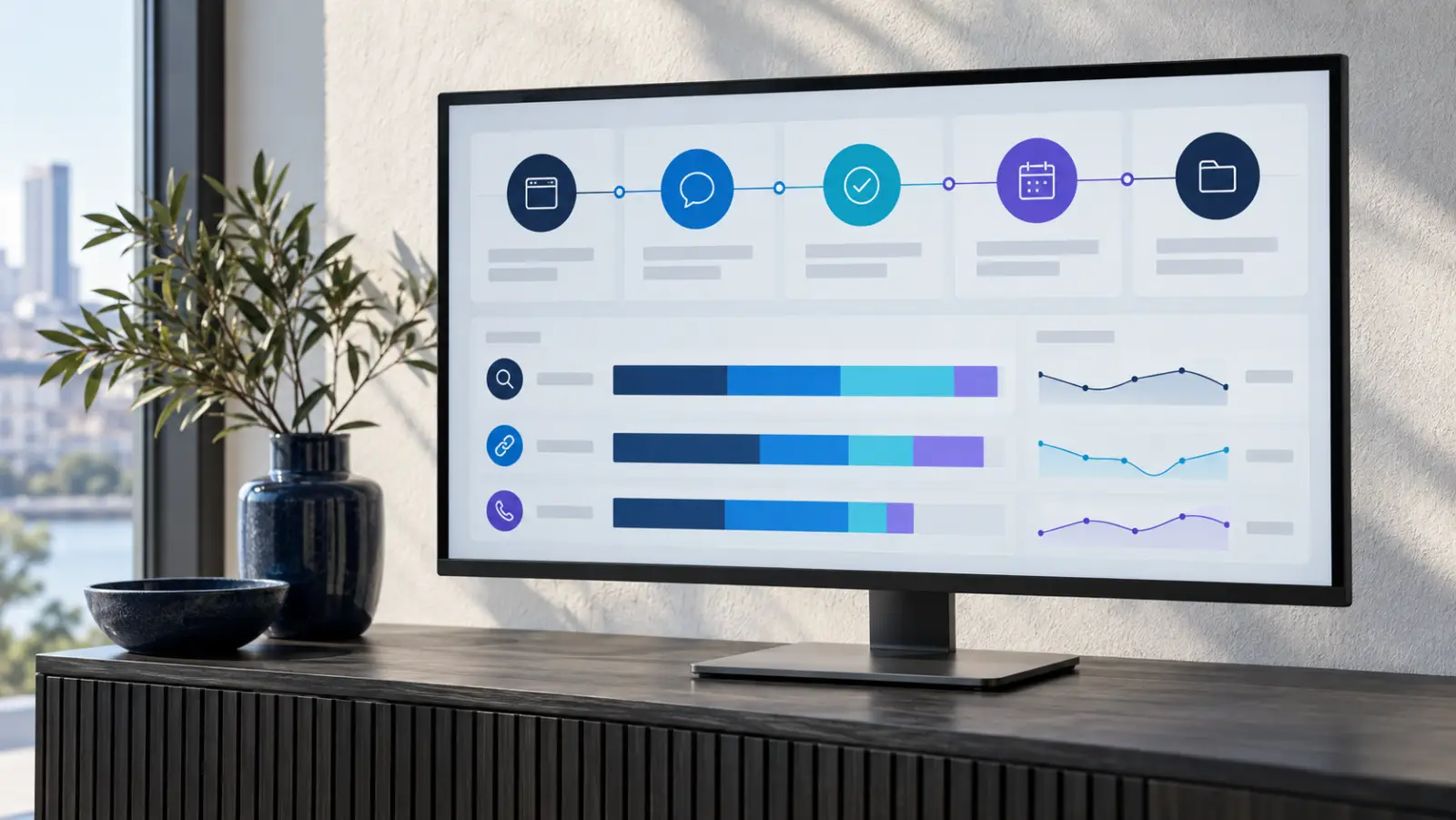
Monitor showing a customer journey timeline with channel breakdown bars.

FAQ

Frequently Asked Questions

Marketing attribution is the assigning of credit to one or more touchpoints within a marketing campaign for influencing a customer’s purchase decision. As such, marketing attribution helps determine which touchpoints in the campaign are working and which are not. Marketing attribution is based on the information and technique used, and as such, may not be comprehensive.

Marketing attribution helps identify touchpoints that lead to a potential customer, but may not always be conclusive. However, we make it clear when we are not certain about a touchpoint and avoid stating a case for it, if the information is not available.

Tracking website visits should be complemented with other qualitative and/or quantitative measures such as customer calls, requests, and conversions; appointment and proposal generation; and purchases. The focus should be on the most useful measures for the business.

Different definitions, time frames, and collection methods can contribute to discrepancies. So can duplicate and missing entries. We identify and review these discrepancies. We capture how the team will interpret the disparate data for a given decision.

The focus should be on the decisions we are hoping to capture rather than the enormous amount of data we need to amass. A report that answers the right questions can enable better management decisions than the largest and most complex dashboard.

The shortest duration for achieving a meaningful outcome will depend on the average length of your sales cycle and the number of reported opportunities.

Focus on Key Decision Areas

If your management reports do not clearly delineate or summarize important information for your business, concentrate on the questions management is unable to answer. SIS can assist your company in answering important management questions and clarifying the answers for the data your company currently captures.